
What Can a World War II Separation Document Tell You?
If you've ever explored your family's history, chances are you've come across an old military discharge tucked inside a folder, a family Bible, or the back of a filing cabinet. To many people, it's simply another document worth saving. To a historian, however, it is often one of the most valuable records a veteran ever brought home.
A World War II separation document—officially known as the WD AGO Form 53-55—was issued when an enlisted soldier left active military service. At first glance, the form can seem intimidating. Dozens of numbered boxes are filled with abbreviations, dates, military terminology, and unfamiliar codes. It's easy to overlook just how much information is contained on a single page.
Yet every line on that form represents a clue.
A soldier's unit can lead to unit histories and after-action reports. A military occupation can reveal the job they performed every day. Campaign names place them within some of history's most significant battles, while awards, overseas service dates, and separation information help build a timeline of their military experience. What appears to be a simple administrative document is often the starting point for uncovering an entire story.
In this article, we'll examine a partially redacted World War II separation document and explore the sections that historians rely on most. Rather than explaining every numbered box, we'll focus on the entries that can open new avenues of research and help transform a single sheet of paper into a deeper understanding of a veteran's service.
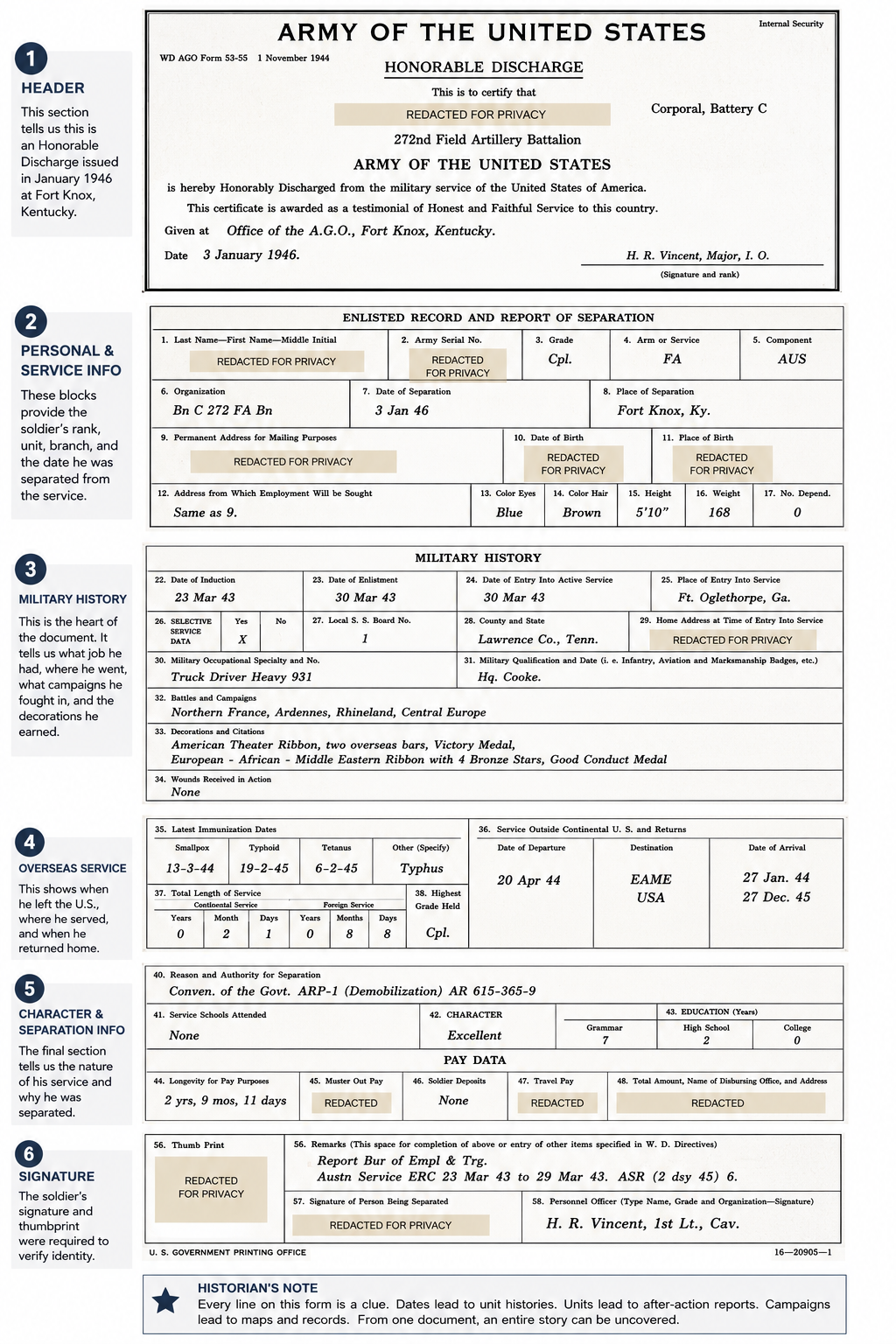
Figure 1. Example of a partially redacted World War II WD AGO Form 53-55 (Enlisted Record and Report of Separation). Personal information has been removed to protect privacy while preserving the document's educational value.
At first glance, the form can appear overwhelming. More than fifty numbered blocks are filled with abbreviations, dates, military terminology, and government shorthand. While the example used throughout this article is a typed form, many World War II separation documents you'll encounter are handwritten. Depending on the individual who completed the form and the quality of the surviving copy, some entries can be difficult to read or interpret. Fortunately, one difficult-to-read box rarely makes the document unusable. The information recorded throughout the form often supports and complements itself, allowing other entries to provide context, confirm details, or even help decipher information that has become faded, damaged, or difficult to read. Rather than examining every box, we'll focus on the sections that reveal the most about a veteran's service and where they can lead your research.
Historian's Note:
Historical research is rarely built on a single piece of evidence. Separation documents are no different. If one field is illegible or missing, the surrounding information often provides enough context to understand what it likely contained or to locate supporting records elsewhere. Historians rely on the combined weight of evidence rather than any single entry.
Understanding the First Entries
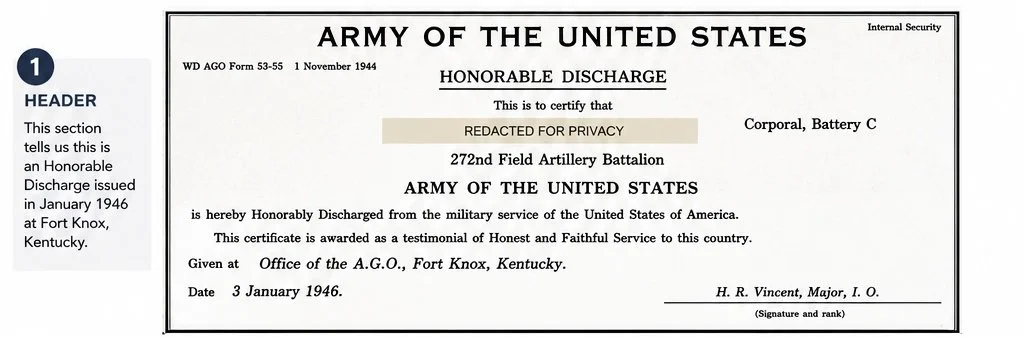
Caption: Figure 2. The opening section of a World War II WD AGO Form 53-55 identifies the veteran, military organization, and basic service information. Personal information has been redacted for privacy.
When historians begin examining a separation document, they rarely start with the awards or campaigns. Instead, they begin at the top of the form, where the Army recorded the soldier's identity and military organization. These seemingly routine entries establish the foundation for everything that follows.
While personal information such as the veteran's name, service number, and home address helps confirm that the correct individual has been identified, the most valuable research clues often begin with the organization listed on the form.
A unit designation is much more than an administrative detail. It tells us where to begin looking for the larger story. Unit histories, operational reports, after-action reports, morning reports, and even wartime photographs are frequently organized by military unit rather than by an individual soldier's name. Knowing a veteran served with a particular company, battery, squadron, or ship can open doors to records that place their service within the broader history of the war.
The veteran's grade and branch of service also provide valuable context. Rank often reflects the level of responsibility a soldier held at the time of separation, while the branch of service helps establish the type of work they performed and the kinds of records that may exist elsewhere.
Although these opening boxes may appear straightforward, they provide the framework that allows the remainder of the document to be understood in its proper historical context. Before asking what a veteran experienced during the war, historians first establish who they were and where they served.
Historian's Note
One of the most common mistakes new researchers make is focusing immediately on medals or famous battles while overlooking the veteran's assigned unit. In many cases, the organization listed near the top of the separation document becomes the single most important clue for reconstructing a soldier's wartime experience. A unit often tells historians far more than a list of awards ever could.
Personal & Service Information
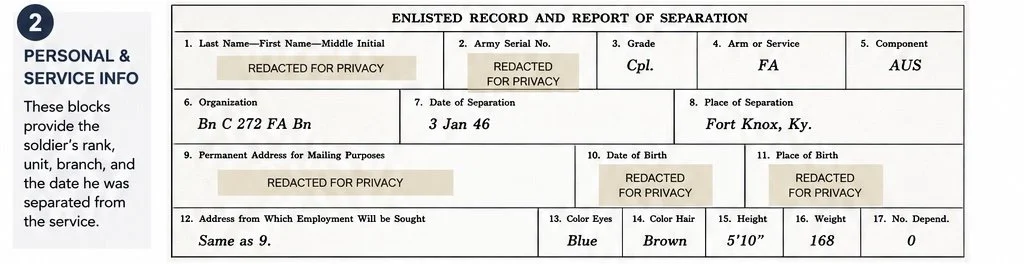
Figure 3. The opening section of the WD AGO Form 53-55 records the veteran's personal information, military organization, rank, and basic service details. Certain personal information has been redacted to protect privacy while preserving the document's educational value.
With the document itself identified, historians next turn their attention to the veteran's basic service information. Although many of these entries appear administrative in nature, they establish the foundation upon which the remainder of the document is understood.
The first entries begin identifying the veteran and record information such as rank, branch of service, organization, and the date and location of separation. While personal details help confirm the identity of the individual, military information often provides the first clues for expanding research beyond the separation document itself.
Among the most significant entries in this section is the organization. Military records were commonly created and maintained by units, making this one of the most valuable pieces of information on the form. Whether researching unit histories, morning reports, operational records, or wartime photographs, knowing a veteran's assigned organization provides a starting point that can lead to a much broader understanding of their military service.
The veteran's grade, or rank, offers additional context. While rank alone does not describe a soldier's experiences, it does indicate the level of responsibility held at the time of separation and can sometimes help explain the duties they performed within their unit.
The date and place of separation are also important. These entries identify when and where the Army officially discharged the veteran from active service. It is worth noting that this date should not be confused with the day the veteran returned home. Many service members spent time at separation centers completing medical examinations, paperwork, and final processing before officially leaving military service.
Although some of the remaining entries, such as physical characteristics or mailing addresses, may appear less significant, they still serve an important purpose. They help distinguish one individual from another, particularly when researching veterans with common names or comparing multiple military records.
Taken together, these opening entries establish the veteran's identity, military organization, and administrative history, creating a framework for interpreting the more detailed military information found later in the document.
Historian's Note
Don't overlook the ordinary details. A rank, a unit designation, or even a separation location may seem routine on its own, but when combined with census records, draft registrations, newspaper articles, unit histories, and other historical records, these details become powerful tools for confirming identity and reconstructing a veteran's story.
Military History
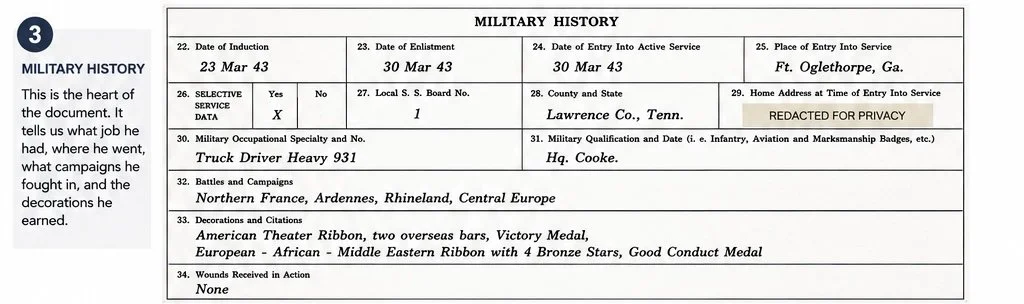
Figure 4. This section of the WD AGO Form 53-55 records the veteran's military occupation, military qualifications, campaigns, decorations, and other details that help historians reconstruct wartime service.
Although every section of a separation document contributes to understanding a veteran's service, this portion of the form often provides the greatest number of research opportunities. In just a few entries, the Army recorded information that can lead historians to unit histories, operational records, campaign studies, and other sources that place a veteran's individual service within the broader history of World War II.
One of the most informative entries is the Military Occupational Specialty (MOS). The MOS identifies the job a service member performed while in the Army. Whether listed as a truck driver, infantryman, clerk, radio operator, mechanic, or another specialty, this information provides valuable insight into the veteran's daily responsibilities. It can also help explain why a soldier may have been assigned to a particular unit or participated in specific operations.
Another key section records the veteran's Military Qualifications and Date, which may include specialized training or qualification badges earned during service. While these entries can highlight individual skills, they should always be considered alongside the veteran's assigned unit and military occupation rather than viewed in isolation.
Perhaps the most recognizable entries are those listing Battles and Campaigns. These campaign names are much more than a list of places. Each represents a specific military operation recognized by the United States Army and provides a timeline of where a veteran's unit served during the war. Campaign participation can guide researchers toward official campaign histories, maps, after-action reports, and other records that provide a much richer understanding of the conditions experienced by the veteran and their unit.
The Decorations and Citations section offers another valuable starting point for research. Awards may recognize participation in campaigns, service within a particular theater of operations, or acts of meritorious service. However, historians should avoid assuming that the list of decorations tells the entire story of a veteran's military experience. Many important duties and experiences are never reflected alone.
Taken together, the entries in this section transform the separation document from an administrative record into a roadmap for historical research. Rather than serving as the conclusion of a veteran's story, these details often mark the beginning of a much deeper investigation.
Historian's Note
It can be tempting to focus immediately on medals or famous battles, but experienced researchers rarely begin there. A veteran's military occupation, assigned unit, and campaign participation often provide far more context than decorations alone. The strongest historical conclusions come from examining how these pieces of evidence support one another rather than relying on any single entry. The unit listed on a separation document is one of the most valuable research clues available, but it should rarely be considered the complete story. During World War II, military units were frequently attached to larger formations, reassigned to different commands, or temporarily placed under the operational control of other units as missions changed. Understanding these relationships can provide a much clearer picture of where a veteran served and the operations in which they participated. Effective military research often involves following the unit's history just as closely as the individuals.
Overseas Service

Figure 5. This section of the WD AGO Form 53-55 records the veteran's service outside the continental United States, including the theater of operations and dates of departure and return.
One of the most valuable sections of the separation document records a veteran's overseas service. While these entries may consist of only a few dates and locations, they provide historians with an important timeline that helps place a veteran within the larger events of World War II.
The dates of departure from and return to the United States establish the period during which the veteran served overseas. Although these dates do not identify every location where a service member was stationed, they create a framework that can be compared with unit histories, campaign participation, and operational records to better understand where the veteran may have served throughout the war.
The theater of operations identifies the geographic region in which the veteran served, such as the European, Pacific, or Mediterranean Theater. This information immediately narrows the scope of research and helps direct historians toward the records, campaigns, and military operations associated with that theater.
When examined alongside the Battles and Campaigns section discussed earlier, overseas service dates become even more valuable. Together, these entries help establish not only where a veteran served, but also when they were present during specific military operations. This combination of evidence often allows researchers to build a reliable timeline of wartime service.
Although the information recorded in this section appears brief, it provides another critical piece of the historical puzzle. By comparing overseas service dates with unit records and campaign histories, historians can place a veteran's military experience within the broader context of the war rather than viewing it as an isolated series of events.
Historian's Note
Dates are among the strongest forms of historical evidence because they can be compared across multiple sources. A veteran's overseas service dates should be examined alongside campaign dates, unit movements, troop ship records, and official military histories. When multiple independent records support the same timeline, historians can reconstruct a veteran's service with far greater confidence than relying on any single document alone.
Character and Reason for Separation

Figure 6. This section of the WD AGO Form 53-55 records the character of the veteran's service, the reason for separation, and the military authority under which the discharge was issued.
As the separation document draws to a close, it records the official conclusion of the veteran's military service. While these entries are often overlooked, they provide important administrative information that helps explain how and why the veteran left active duty.
The Character of Service indicates the official nature of the veteran's discharge. In most World War II separation documents, this will be listed as Honorable, reflecting satisfactory military service. While the character of service is important, it should always be interpreted within the broader context of the veteran's complete military record.
Another valuable entry is the Reason and Authority for Separation. Rather than simply stating that a veteran was discharged, the Army recorded both the reason for separation and the regulation or official authority under which that action was taken. Nearly every separation document includes some type of regulatory citation, although the specific regulation varies depending on the circumstances of the discharge.
These references may appear as little more than a series of letters and numbers. Still, they point to the Army regulation, War Department Circular, or other official directive that authorized the separation. Understanding these citations can provide additional insight into whether the veteran was discharged through routine demobilization, medical separation, expiration of service, reenlistment, or another administrative process.
Although many family historians overlook this section, the authority cited in Box 40 reminds us that every military discharge followed an established administrative process. Even when the regulation itself does not immediately reveal additional details, it often provides another avenue for understanding the circumstances surrounding a veteran's transition from military to civilian life.
Historian's Note
Don't ignore unfamiliar abbreviations or regulation numbers simply because they appear administrative. Military regulations often explain why a veteran's service ended when it did. If a regulation is unfamiliar, researching the cited authority may reveal valuable context that is not immediately apparent from the separation document alone.
Final Certification
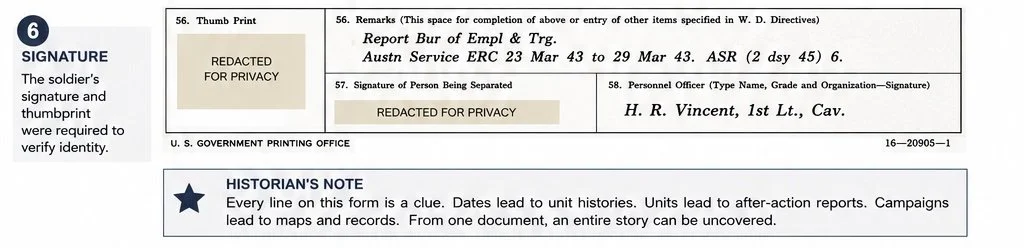
Figure 7. The final portion of the WD AGO Form 53-55 contains the veteran's signature, official certifications, and administrative acknowledgements completed at the time of separation.
The closing section of the separation document may appear to contain little more than signatures and administrative certifications, yet it serves an important purpose. These entries document that the information recorded on the form was reviewed as part of the separation process and that the veteran officially completed the requirements for discharge.
In many surviving copies, signatures may be faded, difficult to read, or omitted entirely due to the way the document was copied or recorded. This is not uncommon and should not automatically raise concerns about the record's authenticity. As with other portions of the separation document, historians evaluate the document rather than relying on any single signature or certification.
Official stamps, certification statements, and filing information can also provide useful clues. Many veterans recorded copies of their discharge papers with a county courthouse after returning home, while others retained only personal copies. These differences may explain why one family's document appears different from another, even though both contain the same essential information.
Although this section rarely answers major research questions by itself, it helps confirm the document's administrative purpose and reminds researchers that every historical record should be evaluated in its complete context.
Historian's Note
Historical records often survive in different forms. An original discharge, a certified copy, a courthouse recording, or a later photocopy may each look slightly different while preserving the same historical information. Differences in appearance do not necessarily indicate differences in accuracy.
Conclusion
At first glance, a World War II separation document may appear to be nothing more than a government form filled with dates, abbreviations, and military terminology. Yet, as we've seen throughout this article, every section contributes another piece to a veteran's story.
A unit designation can lead to operational records. A military occupation reveals daily responsibilities. Campaigns establish where a veteran served, while overseas service dates help construct a reliable timeline. Even administrative entries, such as the authority for separation, provide valuable context about the conclusion of military service.
No single box tells the complete story. Instead, historians compare information across the entire document and then expand their research using unit histories, military regulations, campaign records, census records, newspapers, and other historical sources. It is the combined weight of evidence—not any single entry—that transforms a one-page military record into a deeper understanding of an individual's service.
If you have discovered a World War II separation document among your family's records, take the time to study it carefully. What may first appear to be an ordinary administrative form is often the beginning of an extraordinary historical journey. Every entry is a clue, and every clue brings you one step closer to understanding the life and service of the person who carried it home.
